
Chamomile
Part Two of the making of my album "The Monster Mash"

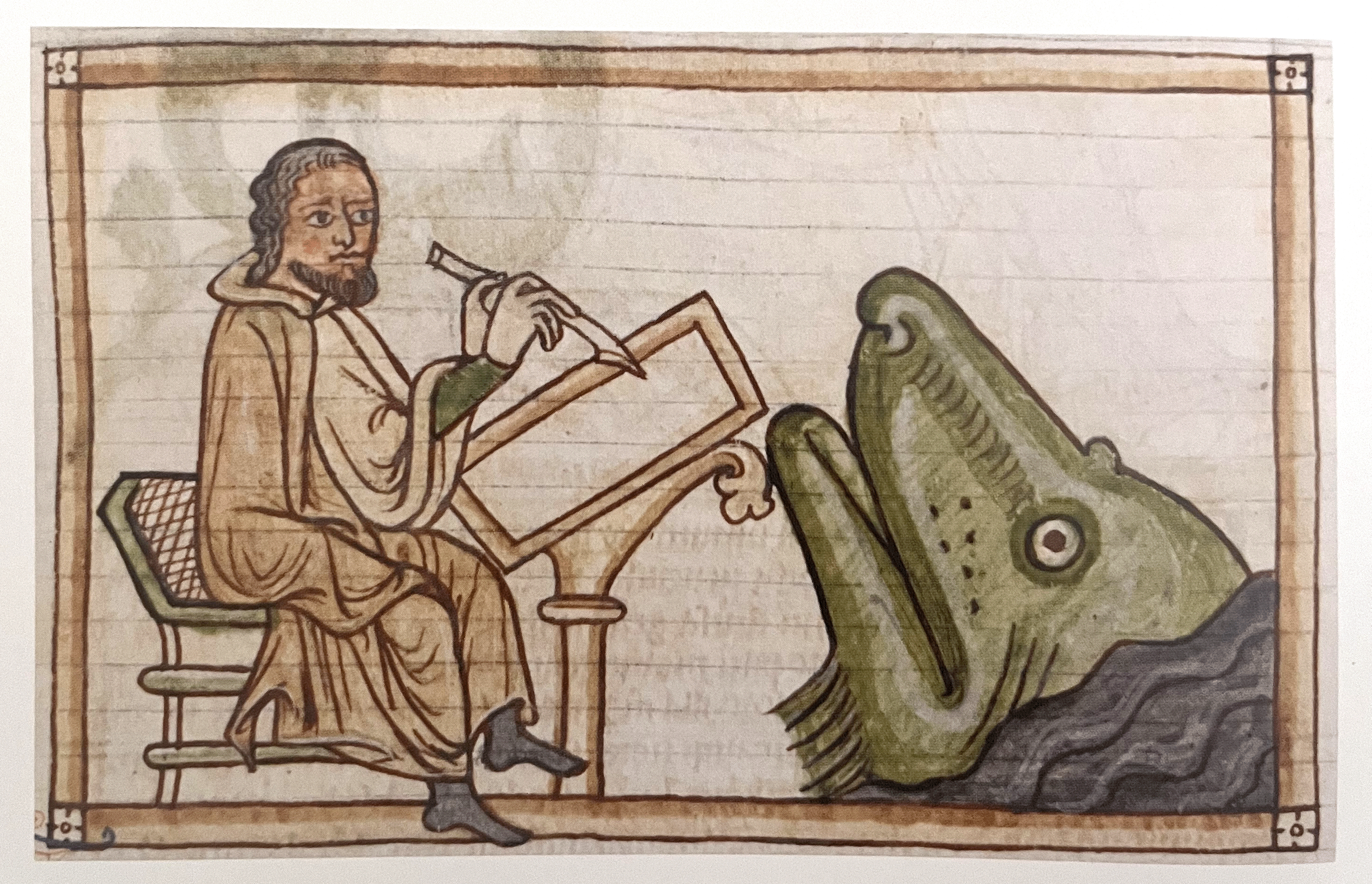
[Amos with pen before a whale, from a bestiary produced in England around 1255-65.]
A friend was once telling me a story about her childhood when this sentence emerged from her mouth:
"My mother washed my hair in chamomile to keep it blonde."
People will sometimes say words like that and leave them at my feet, then move on to something else, as though this weren't the perfect lyric for a song. Do they realize the gifts they are giving? Are they motivated by unseen forces?
Perhaps the Muse takes whatever path can bring inspiration into fruition and speaks through a human voice and you just have to listen for the words that come pre-loaded with their own melody.
Granted, a constant attentiveness to finding such lyrical gifts might not make me the best conversationalist at times, given that there are moments when I hear a random phrase, cock my ear, my eyes fog over, and I start charting out a song in my head, while my friend continues telling the story of her childhood.
This is what I have found to be the entrancing energy of Neptune, a dreamy inspirational force that envelops you in its warm blanket, but can also abscond you from the physical world.
Regardless, I picked that sentence up, quietly nodded my gratitude and went of to write a song. I could never figure out the right format for it, though, first starting on Rhodes electric piano and then electric guitar. But in the summer of 2024 while I played on Kate's Washburn parlor guitar, songs finally worked that didn't work before. What I at first interpreted as a tough and defiant tone in that lyric now had a tenderness and ache to it.
There are two phases of a song. There is the writing of it, which involves constant adjustments, and has the endless possibility that this song could be the one, an undeniable song that conquers the globe with its awesomeness.
And then there is the recording phase, where a bunch of actual decisions have to be made, and you could say that certain compromises occur, and all the potential of the song gets realized into a specific object. Sometimes it's a great object, sometimes a wonderful object, but still just one singular object.
When a song is being written, the goal is pretty clear: let the song be born. But once you go to record it, things become confusing. Is our goal to pin the song under glass, to have it as a pristine example of itself? Or is the goal to have it be imperfect and smoldering?
Either way, you can't avoid that a record is a snapshot of a moment in time. The question then is do you want the fullness of the surrounding context of your life to be present in the music? Or do you want to trim that all off and make everything more presentable?
That summer I was sitting in a bar in Seattle after a show explaining my current life story to a woman with silver rings on her fingers. I found that my life story would always have to follow whenever I was asked the simple question "Where do you live?" because my response to that always began with "It's complicated."
I was used to telling my story to people and have them back away slowly, adjust their sleeves, say "Sorry about all that," but this woman took it all in, all the baffling coincidences and unfortunate disintegrations, and thought for a second while she sipped her drink.
"Look," she said, "this might be because of my background in theoretical physics, but... It sounds to me like you've jumped universes."
I will admit, after almost a year of conversations with energy workers, therapists, coaches, friends, and family, this was the most sensical thing I had heard. I snapped my fingers and said, "Yes!" Finally, someone had an answer, something that didn't flinch around the big truths. If I had jumped into a completely different universe, I wanted to know about it.
But right after she said that, there was a stir in the bar as the group of people we were there with decided they needed to relocate somewhere else. I wanted to continue this conversation, to find out more about what it meant to skip universes, but I kept getting separated from this woman.
Like a dream, a joint was handed to me, the moon looked so big that it could've crushed us, we walked up a street with colorful blobs on the walls while unseen construction workers sounded like they were grinding the very pipes that led to Hell.
I thought to myself, When I tell this story later, how will I make it clear that this wasn't a dream?
Forget that, it's impossible. Finally, at the end of the night, I found my way back to this woman We were going our separate ways and her Uber was coming in one minute.
"Wait—can I jump back?" I asked her. "To the old universe."
"Nope. Sorry. That's where the faith comes in. Think of it as a pivot."
"But it's devastating," I said. "I've lost so many friends."
"You haven't lost them," she said. "The orbit just changed."
"What do you mean?"
"True friends will always find you because of magnetism."
And then she was gone, whisked away into the night. I shuffled down the street to the parking garage where my car was parked, only to find that it was closed for the night and my car was trapped.
It did indeed feel like great changes were happening all around me, like an old cartoon where someone blithely walks across steel beams as cranes lift them up and twirl them around. Sometimes you are separated from your home, your family, your car. Sometimes you even lose the narrative that you are a good person, you lose the people that reflected meaning in your life. When all of that is gone, what remains?
The most impactful therapy situations have involved a process of me going back to younger parts of myself and guiding that youth through the difficult periods with the wisdom of my older self. But how do you guide yourself through tumultuous times when they are currently happening? Is there an even older version of you who can come comfort you?
Perhaps that was the tenderness I now found in "Chamomile." It wasn't a song about losing innocence, it was a song about the moments when a fragile part of you was once cared for. To take chamomile tea and try to keep hair blonde is a very sweet, and perhaps futile, act.
In my book Hitomi I wrote this:
"Writing a poem is like trying to halt a supertanker by holding a dandelion up to it. You can laugh at the frivolity of it. You can ridicule the person for doing such a thing. But—and I'm not saying this makes you one of them—when you laugh at poets, you laugh alongside tyrants. You are standing next to the powerful and the angry and the rich, and you might as well be a bully too, laughing at the weak person cutting snowflakes out of tissue paper. Yes, you are right. But is right everything you want to be?"
Months later, in the studio, "Chamomile" migrated to electric guitar, some of the defiance returned to the singing, and it ended up not fitting with the rest of the album The Monster Mash. It's a slippery thing to figure out how to record the proper version of a song. You'll have it right in front of you and then it's gone, like a dream. Maybe it made sense in one universe, and maybe we are not in that same universe.
However, to sum up, the first two songs that were the most promising candidates for inclusion on this album didn't end up making it onto the finished version.
Regardless, here is a demo of "Chamomile" from Kate's living room on her Washburn guitar.
My new album, The Monster Mash, available on Bandcamp.
I love reading these, Nick. Keep ‘em coming!